Getting the size right is the most important decision you'll make when buying a heat pump - and the one most people get wrong.
Too small, and the unit will struggle to reach temperature, running your power bill into the ground while leaving you shivering. Too large, and it will "short-cycle," constantly turning on and off, which wears out the compressor and fails to dehumidify the air. Either way, you're paying more than you should and getting less comfort than you deserve.
This guide explains how heat pump sizing works, what factors matter in a Waikato home specifically, and how to choose a kilowatt (kW) rating that actually stands up to a frost. It won't replace a proper in-home assessment, but it'll give you a solid starting point before you talk to anyone.
Why sizing matters more in Waikato than you might think
Heat pump sizing is calculated against outdoor temperature. The colder it gets outside, the harder a heat pump has to work to maintain your indoor temperature, and the more capacity it needs to do that effectively.
In places like Auckland or Tauranga, a unit sized for the average winter day will cope fine most of the time. Here in the Waikato, though, the temperature inversions that pool cold air in the Hamilton basin mean we regularly see overnight lows of 0–3°C - and some mornings that feels even colder thanks to our high winter humidity.
What affects the size you need
Floor area is only the beginning of the story. Here's what else goes into a proper sizing calculation:
Room type and how it's used
A bedroom you heat for a few hours at night needs a different unit than an open-plan kitchen and living area that runs all day. Ceiling height matters too - a 2.7m ceiling holds significantly more air volume than a standard 2.4m one, and that air all needs to be heated.
Insulation
This is the biggest variable in Waikato homes. A well-insulated new build holds heat efficiently, whereas an older villa with no ceiling insulation and single-glazed windows loses it almost as fast as you put it in. The same 30m² room can need very different heat pump capacities depending on what's in the walls and ceiling.
Glazing
Windows are where most heat escapes. Single glazing is common in older Waikato homes and makes a meaningful difference to how much capacity you need. Double glazing, and especially double-glazed doors, significantly reduces heat loss and can drop the required kW rating by more than you'd expect.
Orientation and sun exposure
A north-facing living room with good afternoon sun needs less heating grunt than a south-facing room that barely sees the sun in winter. In coastal spots like Raglan, where many homes are designed with massive windows to capture western sea views, afternoon solar gain can be immense. Here, you might actually need to size up slightly on cooling capacity to keep the home comfortable in February, even if your winter heating needs are modest.
How well the space is sealed
Draughty older homes - common in the likes of Hamilton's established suburbs and in Cambridge and Te Awamutu's older housing stock - lose heat through gaps around doors, windows, and floors. Sealing these up first can reduce the size of the unit you need and lower your running costs considerably.
Heat pump sizing guide for Waikato homes
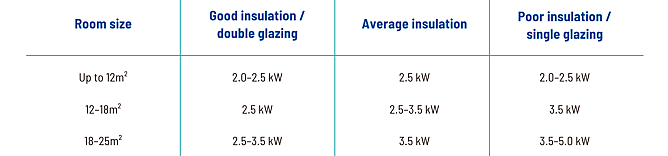
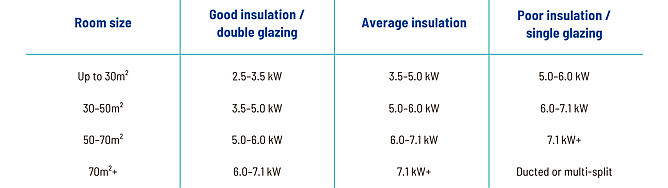
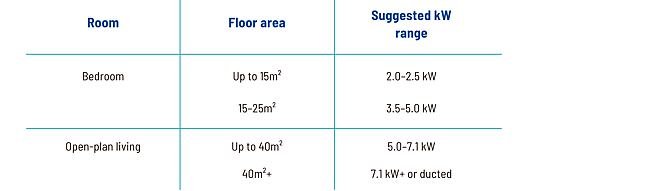
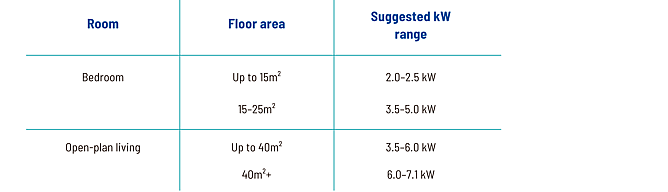
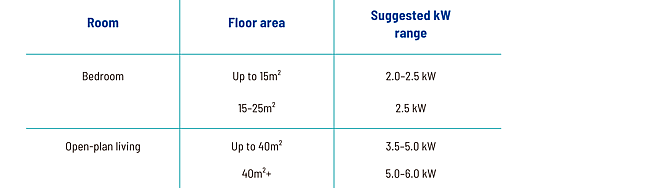
Use the tables below as a starting reference. These are based on standard ceiling heights (2.4m) and typical Waikato winter conditions. If your home is older, poorly insulated, or has high ceilings, move toward the upper end of the range, or step up to the next category.
Bedrooms
Open-plan living, kitchen, and/or dining
Home office and/or study

Note: These are indicative ranges based on Waikato climate conditions and standard ceiling heights. Actual requirements vary, particularly in older homes, homes with high stud heights, or spaces with large glass areas. An in-home assessment will give you a precise recommendation.
Older villa vs newer build: why it makes such a difference
The two extremes we see most often in the Waikato are the pre-1980s villa and the modern new build, and they couldn't be more different when it comes to heating requirements.
Older villas and bungalows (pre-1980s)
Common across Hamilton's inner suburbs - Frankton, Claudelands, Melville, Dinsdale - and throughout Cambridge, Morrinsville, Matamata, and Te Awamutu's older residential areas. You’ll also find plenty of these uninsulated, drafty properties tucked away as original batches and older homes in Raglan. These homes typically have:
Little or no underfloor insulation
Ceiling insulation that's been retrofitted but may be incomplete
Single-glazed windows throughout
High stud heights (2.7m or more) in older designs
Draughts through floorboards, window frames, and exterior doors
For these homes, you'll generally need a unit at the upper end of the size range for your room, or potentially a step up. The heating load is simply higher. The good news is that even a well-sized heat pump will dramatically outperform whatever older heating solution was in there before.
Newer builds (post-2000, especially post-2008)
Common in Rototuna, Flagstaff, Peacocke, and the newer developments in Cambridge and Te Awamutu. These homes typically have:
Full ceiling, wall, and underfloor insulation to current code
Double-glazed windows and thermally broken frames
Better draft sealing throughout
Standard 2.4m stud heights
These homes are significantly more efficient to heat. You'll often find you need a smaller unit than you expected, and that it does the job very comfortably. Oversizing is actually a more common mistake in well-insulated new builds than undersizing.
Quick sizing reference: find your starting point
Older villa or bungalow
1980s - 2000s home
Modern new build
What to do once you have a range
A kW range is a useful starting point, but it's not the end of the conversation. Before you decide on a unit, it's worth:
Checking the specific model's low-temperature performance - in Waikato, how a unit performs at 2°C outdoor temperature matters more than its rated capacity at 7°C
Considering the room's position in the house - a room that shares walls with other heated spaces needs less capacity than one exposed on three sides
Thinking about usage patterns - a room that needs to heat from cold every morning needs more capacity than one that's kept at a steady background temperature
Looking at the unit's noise rating if it's going in a bedroom - under 22 dB on low is what you want
If you're unsure about which specific model to choose, our guide to the best heat pumps for Waikato winters covers the models we install most often and how they compare on all of these factors.
Get a free in-home assessment
The tables above will get you in the right ballpark. But the only way to know exactly what you need is to have someone look at your home properly, including your insulation, windows, ceiling height, which way the room faces, and how you use the space.
At Aircon Group Waikato, we offer free, no-obligation in-home assessments across Hamilton, Cambridge, Te Awamutu, Raglan, and the wider Waikato region. We'll work out the right size for every room you want to heat, recommend the best unit for your situation and budget, and give you an honest quote.
Call us on 0508 224 7687 or request a free quote - we'll come to you.

FAQ's
Q: What happens if my heat pump is too small for the room?
A: It runs constantly trying to keep up, especially on cold Waikato mornings - and often still can't reach your target temperature. Over time, running flat out shortens the unit's life and drives up your power bill. It's the most common sizing mistake we see, particularly in older Waikato homes where people have gone off floor area alone without accounting for poor insulation.
Q: What happens if my heat pump is too big?
A: It heats the room quickly then shuts off, then kicks back in again - a pattern called short-cycling. This is hard on the compressor, reduces efficiency, and often leaves the room feeling less comfortable than a correctly sized unit would. It's a particular risk in modern, well-insulated new builds where people assume they need more capacity than they do.
Q: Is a 2.5 kW heat pump big enough for a Waikato bedroom?
A: For a standard bedroom up to about 15m² in a reasonably well-insulated home, yes - a 2.5 kW unit is usually sufficient. In an older villa with single glazing, or a larger bedroom, you'd want to move up to 3.5 kW. The cold mornings we get in Hamilton and the Waikato basin mean it's worth erring slightly on the side of more capacity rather than less.
Q: Do I need a bigger heat pump because I'm in the Waikato?
A: Often, yes, especially compared to Auckland or Tauranga. However, it depends on where you live in the region. Temperature inversions in the Hamilton basin, Matamata, and South Waikato can keep overnight lows below 3°C for weeks at a time, requiring more heating capacity. If you are on the coast in Raglan, your winter temperatures are milder, but your unit will have to work harder against moisture and wind, meaning proper sizing is still crucial to avoid rust and short-cycling.
Q: How does insulation affect what size heat pump I need?
A: More than almost any other factor. A poorly insulated room - such as an older villa with no underfloor insulation and single-glazed windows - can need double the capacity of the same size room in a well-insulated new build. If your home has limited insulation, improving it before installing a heat pump can reduce the size (and cost) of the unit you need, and significantly lower your ongoing running costs.
Q: Can one heat pump heat my whole house?
A: A single wall-mounted unit can heat an open-plan space effectively, but it won't reach into closed rooms. For whole-home heating you have three options: multiple wall-mounted units in key rooms; a multi-split system (one outdoor unit, multiple indoor units); or a ducted system that runs throughout the home from a single outdoor unit. We can talk you through which approach makes the most sense for your home.
Q: What's the difference between kW and kWh?
A: kW (kilowatts) is the capacity - how much heating power the unit can deliver. kWh (kilowatt-hours) is the energy it uses over time, which is what shows up on your power bill. A 5.0 kW heat pump running for an hour doesn't use 5 kWh of electricity - it uses much less, because heat pumps move heat rather than generate it. A unit with a COP of 4.0 will use roughly 1.25 kWh of electricity to deliver 5 kWh of heat. Our running costs guide covers this in more detail.
Q: Do I need to tell my landlord if I want a heat pump?
A: If you're renting, yes - you'd need your landlord's permission to install a heat pump. Landlords in New Zealand are required under the Healthy Homes Standards to provide a compliant fixed heating device in the main living area. If your rental doesn't have adequate heating, that's a conversation worth having with your landlord - and we install and service heat pumps for rental properties across the Waikato.