One of the first questions people ask when they're thinking about a heat pump is what it's going to cost to run. It's a fair question - and one that deserves a straight answer rather than a vague "it depends."
In short, a heat pump costs significantly less to run than most other heating options available to Waikato households. The longer version, though, depends on your home, your usage, and the unit you choose. This guide works through real examples so you can see what the numbers actually look like.
Why heat pumps are cheaper to run than other heating
Most heating works by converting electricity directly into heat. A panel heater drawing 2 kW of power produces 2 kW of heat in a straight one-to-one conversion.
A heat pump works like a "heat transporter." Instead of generating heat (like an oven or toaster), it uses electricity to extract ambient heat energy from the outside air and move it indoors. Even when it’s 2°C on a foggy Hamilton morning, there is still usable heat energy in the air. Because the unit is moving heat rather than creating it, it’s especially efficient. This ratio is called the COP (Coefficient of Performance).
In Waikato winter conditions - cold, damp, and frosty - a quality inverter heat pump will typically run at a COP of 3.0 to 4.5. This means for every $1 you spend on power, you get $3 to $4.50 worth of actual warmth. Compare that to a panel heater or oil column, where $1 spent always equals exactly $1 of heat.
Because COP is tied to outdoor temperatures, where you live in the Waikato slightly shifts your day-to-day running costs. For instance, a heat pump running on a frosty, -1°C morning in Tokoroa or Matamata has to work a bit harder (lowering the COP temporarily) than a unit operating in Raglan’s milder, coastal winter air. However, because Raglan homes often battle high humidity, the unit will spend more time in dehumidification mode. Either way, a heat pump vastly outperforms standard plug-in heaters across the entire region.
What does it cost per hour?
These figures are based on a typical Waikato electricity tariff of around $0.30–0.32 per kWh, which is broadly in line with what most households in Hamilton, Cambridge, and Te Awamutu are paying in 2026. Your actual tariff may vary - check your power bill for your exact rate.
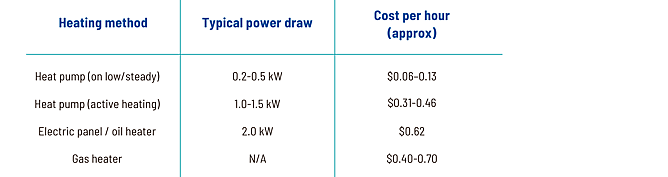
It’s easy to be tempted by a low-cost plug-in heater - they're cheap to buy, but the most expensive way to heat a room. While the upfront cost of a heat pump is higher, it’s a self-funding investment. For a typical four-bedroom family home in the Waikato, the massive reduction in power bills means the unit effectively pays for itself in just 2 to 3 winters. For the remaining 10+ years of the unit’s life, that’s money staying in your pocket rather than being handed over to the power company.
Waikato insider tip: If your home is in Hamilton, Raglan, Morrinsville, or Ngaruawahia, you are likely on the WEL Networks grid. This means you may receive the annual WEL Energy Trust discount on your power bill, making your actual net running costs even lower. If you are in Cambridge (Waipa Networks) or Matamata (Powerco), your lines company structures things slightly differently, but the hourly efficiency math remains incredibly strong.
Worked examples: three common Waikato scenarios
These examples use conservative assumptions: a Waikato electricity rate of $0.31/kWh, a quality inverter heat pump running at an average COP of 3.5 across typical winter conditions, and realistic usage patterns for each home type.
Scenario 1: Two-bedroom unit or apartment
Profile: Two adults, no kids. Heat the living area through the day and into the evening, bedroom overnight on low.
Heat Pump Total: ~$0.94/day ($28/month)
Panel Heater Total: ~$7.48/day ($224/month)
Approximate winter saving: $780–$800
Scenario 2: Four-bedroom family home
Profile: Two adults, two or three kids. Main living area heated from morning through evening, primary bedroom overnight, kids' rooms from after school until bedtime.
Heat Pump Total: ~$2.45/day ($74/month)
Panel Heater Total: ~$18.23/day ($547/month)
Approximate winter saving: $1,850–$1,900
Scenario 3: Home office
Profile: One person working from home full-time through winter. Single room, heated during working hours.
Heat Pump Total: ~$0.56/day ($11.20/month)
Panel Heater Total: ~$3.76/day ($75.20/month)
Approximate winter saving: $250 per winter
How to keep running costs low
A well-chosen, correctly sized heat pump is already significantly cheaper to run than the alternatives. But how you use it makes a difference too.
Set your thermostat to 18–20°C and leave it there
The most common mistake people make is cranking the heat pump up to 26°C when they come home to a cold house, thinking it'll warm up faster. It won't - inverter heat pumps reach target temperature at roughly the same speed regardless of the set point, and overshooting just means the unit runs longer and uses more power. Set it to 20°C and leave it.
Use the timer, not the on/off switch
Turning a heat pump on and off repeatedly is less efficient than running it on a timer. Set it to come on 20–30 minutes before you need the room warm, and to turn off 20–30 minutes before you leave. Most modern units have weekly timer programs - use them.
Use night setback, not off
In bedrooms especially, dropping the set point to 16°C overnight rather than turning the unit off completely is more efficient than letting the room go cold and reheating it from scratch in the morning. This is called night setback, and it makes a noticeable difference on cold Waikato mornings when your unit would otherwise have to work hard to bring the room back up to temperature quickly.
Clean your filters every four to six weeks
A clogged filter forces the unit to work harder to push air through, reducing efficiency and increasing running costs. It takes about two minutes - rinse the filter under the tap, let it dry, and clip it back in. During winter when your heat pump is running daily, do it every four weeks.
Keep doors and windows closed
Obvious, but worth saying. A heat pump heating a sealed room will reach temperature faster and hold it more efficiently than one fighting draughts and open doors. In Waikato winters especially - where cold air can push in quickly - this makes a meaningful difference.
Don't heat rooms you're not using
If you have multiple heat pumps or a multi-split system, only run the units in rooms that are occupied. Heating an empty room all day is the fastest way to inflate your power bill unnecessarily.
How does running cost compare over time?
The upfront cost of a heat pump is higher than a $50 plug-in heater. However, for a typical four-bedroom family home in Hamilton, the $1,850 annual saving means the unit pays for itself in just 2 to 3 winters. For the remaining 10+ years of the unit's life, that's money staying in your pocket rather than going to the power company.
Get a free in-home assessment
The figures in this guide are based on typical Waikato homes and usage patterns. Your actual running costs will depend on your specific unit, insulation levels, electricity tariff, and how you use your home.
At Aircon Group Waikato, we offer free, no-obligation in-home assessments across Hamilton, Cambridge, Te Awamutu, and the wider Waikato region. We'll recommend the right unit for your home and give you an honest picture of what it'll cost to run - before you commit to anything.
Call us on 0508 224 7687 or request a free quote - we'll come to you.

FAQ's
Q: How much does it cost to run a heat pump all day in winter in Waikato?
A: It depends on the size of the unit and the room, but as a rough guide, a 5 kW heat pump running for eight hours in a main living area will cost somewhere between $3.50 and $6.00 in electricity - depending on your tariff and how hard the unit is working. That compares to $15–$20 or more for panel heaters trying to achieve the same result in the same space.
Q: Is it cheaper to leave the heat pump on all day or turn it on and off?
A: For most Waikato homes, leaving it on at a steady set point... is more efficient than repeatedly heating from cold. This is especially true if you are trying to combat the stubborn, deep fog of the Hamilton basin or Morrinsville flats. However, if you live in a well-insulated modern build, or a sun-drenched home in Raglan that gets plenty of natural afternoon warmth, turning it off when you're out for more than 4-5 hours is usually the better call.
Q: Does a heat pump use a lot of electricity?
A: Less than most people expect, and far less than conventional electric heating. The reason is the COP - a heat pump produces three to four times more heat per unit of electricity than a panel heater does. On a typical Waikato winter day, a correctly sized heat pump costs a fraction of what plug-in heating would cost for the same warmth.
Q: What temperature should I set my heat pump to in winter?
A: 18–20°C is the range recommended by health authorities for comfortable, healthy indoor temperatures. Setting it higher doesn't warm the room faster - it just keeps the unit running longer once it gets there, using more electricity in the process. If you're finding 20°C isn't warm enough, the more likely issue is insulation or a unit that's undersized for the room, not the thermostat setting.
Q: Does cleaning the filter on a heat pump really make a difference to running costs?
A: Yes - a noticeably clogged filter can reduce airflow significantly, forcing the unit to work harder to move the same amount of heat. Over the course of a Waikato winter with the heat pump running daily, that adds up. Two minutes every four to six weeks is genuinely worth it. Your unit's manual will show you exactly how to remove and clean the filter.
Q: How much can I save by switching from panel heaters to a heat pump?
A: Based on the worked examples in this guide, a typical Waikato household switching from panel heaters to heat pumps can save anywhere from $800 to $1,900+ per winter depending on home size and usage. Over the 10–15 year life of a quality heat pump, that's a significant sum - and it doesn't account for the improved comfort, which most people consider just as valuable.
Q: Are there any government subsidies for heat pump installation in New Zealand?
A: EECA (Energy Efficiency and Conservation Authority) has run insulation and heating subsidy programmes through Warmer Kiwi Homes in the past, and similar schemes may be available depending on your circumstances - particularly for low-income households or those receiving certain benefits. It's worth checking the EECA website or asking us when you call, as eligibility and available funding can change.
Q: What's the most efficient heat pump setting overnight in a Waikato winter?
A: Rather than turning it off completely, set the bedroom unit to 16–17°C overnight. This keeps the room from going cold entirely, which means the unit barely has to work - and you avoid the energy spike of reheating a fully cold room first thing in the morning. Most people find they sleep better in a slightly cooler room anyway, so this tends to be comfortable as well as efficient.